


Rupert's Fun Facts

Rupert is Katie's teaching assistant.
His imaginative contribution to lessons is always welcome. Now Rupert is making his debut in writing, with some novel ideas about harps and harping.
The harp comes in numerous different shapes and sizes, it is a rich and fascinating instrument, with many distinct varieties from around the world. It has played an important role in mythology and history. Rupert hopes to explore all aspects of the harp in this blog.

If you would like to hear about Rupert's latest posts please complete the mailing list form at the bottom of this page.
Cousineau Père et Fils
In the years after the French Revolution the epicentre of harp making in Europe moved from Paris to London. No doubt various factors contributed to this shift: possibly the market for new harps dried up in France; makers with ties to the aristocracy may have been fearful of advertising their presence in the revolutionary fervour of the times; or they simply grew too old to work. The fact that Sébastian Erard chose London for his new workshop in 1792 secured its position as the focal point of the nineteenth century harp industry.
However, a few key players did remain in Paris: Sébastian’s brother Jean-Baptiste Erard continued to run Erard Frères making pianos and harps; Georges Cousineau with his son Jacques-Georges Cousineau maintained a workshop making a wide range of instruments and publishing music; and the various members of the influential Naderman family all remained.

Cousineau single-action pedal harp
Victoria and Albert Museum London
Georges Cousineau was born to a poor family in western France probably in 1732 and was raised in Paris by relatives who included the harp maker Salomon (see "Who made single-action harps", 16 May 2026). By the age of 17 he was apprenticed to the luthier François Lejeune and in 1758 he became a master artisan with his own workshop in the parish of Saint Séverin, just south of Notre Dame. By 1773 he was selling music and English pianos and he had moved his workshop to rue des Poulies close to the Lourvre palace, where he made a wide variety of musical instruments including single-action harps. He provided harps to Madame Elisabeth the King’s sister, the Comtesse d’Artois and Marie Antoinette thus earning the title “Luthier de la Reine”.
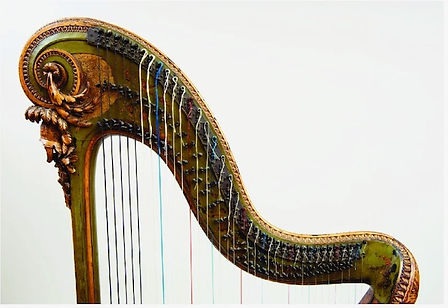
Cousineau was a consummate inventor and innovator; Around 1780 he created his trademark béquilles mechanism for shortening the strings of harps (see "The advent of the single-action harp", 22 April 2026) and in 1782 he built a fourteen pedal harp which made the instrument fully chromatic (see"Towards Double-action", 7 June 2026). Unusually the necks of many of his harps included a glass section revealing the harp mechanism behind.
Around 1783 Cousineau brought his son Jacques-Georges Cousineau into the business creating the firm “Cousineau Père et Fils”. Jacques-Georges, born 1760, was already an accomplished harpist who first started playing with the Paris Opera at the age of seventeen. As a partner with his father he helped to expand the music publishing side of the business including adding his own compositions and exercises.
.jpeg)
Cousineau exposed mechanism
Victoria and Albert Museum London

Capital of harp made for the restored Bourbon family with chevilles tournantes mechanism.
Courtesy of Musée de la Musique, Paris
On the outbreak of the revolution the father and son moved their business back south of the river to the rue de Thionville, (formerly and subsequently named Rue Dauphine) further expanding their music publishing business which was to become more important than their luthier work. From here in 1799 the father and son together with one Michel Rouelle patented the “chevilles tournantes” harp mechanism in which the shortening of strings was achieved by rotating the tuning pins. This had the advantage that as the tuning pins were connected directly to the pedals the strings were not being worn by the repeated contact with the béquilles. The Cousineau workshop would make single-action harps with this mechanism for more than twenty years. It is known that Sébastian Erard subsequently attempted to use this mechanism on double-action harps but without success.
The change in regime following the revolution led to a change in the style of harps as the Cousineaus along with other makers abandoned the Louis XVI scroll in favour of the flat topped "Empire-style" capital.
Georges Cousineau died in 1800 leaving the business to his son Jacques-Georges who continued to make and sell harps in post-revolutionary Paris. He became harp teacher to the Empress Joséphine from 1804 to 1809 and later provided harps to the restored Bourbon royal family. A harp thought to have been made around 1820 and bearing the inscription ‘Cousineau luthier de SAR Monsieur frère du Roi’ is now housed at the Musée de la Musique in Paris. But Jacques-Georges was struggling with crippling debts left by his father, in 1822 he retired from harp making and later sold the business to a French music publisher, he died in 1836.

Capital of Empress Joséphine's harp
Courtesy of Musée des Châteaux de Malmaison et de Bois-Préau
Sources:
Adelson, Roudier and Duvernay.Rediscovering Cousieau's Fourteen-Pedal Harp
Fanny Guillaume-Castel, The transformations of the pedal harp in Paris and
London, between 1749 and 1811
Almanach Musical, Paris 1783
Musée de la Musique, Paris
Musée des Châteaux de Malmaison et de Bois-Préau
24 September 2026
The Charlecote Park Pedal Harp
Imagine trying to play a harp in a rather cumbersome dress, with huge skirts supported by a hooped crinoline. You hold the harp as you position yourself in front of your stool but the crinoline knocks over the stool, you lose your balance and crash to the ground pulling the harp down with you. Well that happened to Mary Elizabeth Lucy in the mid 1800s, she was quite badly bruised but more importantly her harp was apparently fine.
Mary Elizabeth Williams was born at Bodelwyddan Castle in North Wales, she was the daughter of a wealthy family, and an heiress. In 1823 she married George Hammond Lucy, Member of Parliament for Falmouth in Cornwall and owner of Charlecote Park in Warwickshire. Miss Williams was a proficient musician and an accomplished harpist. Within days of her marriage she and her husband visited Erard’s in London to choose a harp. The Erard ledger gives nothing away about the instrument she chose except that it was number 3458, a double-action model, though it is recorded that in 1878 the harp was repaired for Mr John Thomas at a cost of seventeen pounds.
John Thomas was an eminent harpist and composer of the Victorian era who became Harpist to the Queen in 1872. He first met Mary Lucy around 1852 when they both attended an Eisteddfod in south Wales. They quickly became friends, Mrs Lucy acting as one of his patrons and Mr Thomas helping her to improve her harp technique. They remained friends for the rest of her life; Thomas frequently visited Charlecote teaching and playing; both his “Souvenir du Nord” from 1854 and his “Grand Duet” written in 1865 were dedicated to “Mrs Lucy of Charlecote Park”.
.jpeg)
Erard Gothic Pedal Harp
Charlecote Park, Warwickshire
As every harpist knows one harp is never sufficient and it is known that Mary Lucy owned at least three harps during her life. One of these harps remains on display at Charlecote Park, now owned by the National Trust. It is a magnificent instrument, an Erard Gothic, number 5618 made in 1844; this model of harp was developed during the 1830s and gradually displaced the smaller, quieter Grecian. The Charlecote instrument was originally bought by Mr Chichester of Burton Constable Hall in Yorkshire; it is not known when the harp moved to Charlecote but the Erard ledger entry notes that it was repaired for Mrs Lucy in June 1881 for two pounds and eight shillings.

Erard Gothic Pedal Harp Pillar
Charlecote Park, Warwickshire
The harp is decorated throughout with blue japanning, varnish and gilt. It has a highly decorative twisted and pillared column surmounted by a striking coronet. There are eight pedals, seven to adjust string pitch and one to operate the swell shutters which are still in place. The purpose of the shutters is to increase the volume, brightness and resonance of the instrument when open by allowing air to move through the sound box; when closed a more distant muffled sound is produced.

Erard Gothic Pedal Coronet
Charlecote Park, Warwickshire
It is easy to imagine this harp being a prized possession, it is staggeringly beautiful.
Sources:
Erard Ledgers: Royal College of Music Library
Mistress of Charlecote: Mary Elizabeth Lucy, Orion Books
http://www.adlaismusicpublishers.co.uk/pages/harpists/john_thomas.html
https://momh.org.uk/exhibitions/john-thomas-1826-1913/
16 September 2026
The modern double-action harp
Having established himself as a successful harp maker in London Sébastien Erard turned his attention to the task of creating a fully chromatic harp. In 1782 Georges Cousineau had invented a harp with fourteen pedals (see “Towards double-action”, 7 June 2026) but the instrument was not a success. At some stage after 1796 Erard acquired the prototype of the fourteen pedal harp in order to study its mechanism. It seems that his key objective was to design an instrument which would require only seven pedals, so that it would be easy for the player to make the transfer from a single to double-action instrument.
Erard’s first intention was to use a mechanism in which tuning pins were turned to increase the pitch of the string when the pedal was depressed. Cousineau had already patented a single-action harp with such a mechanism but Erard introduced a double notch arrangement for the pedal to allow the tuning pins to be turned twice. However, it seems the mechanism could not be made to work reliably, the harp did not go into production and only the prototype from 1800 was made.

Erard double notch pedal arrangement
Met Museum New York
In the first decade of the nineteenth century sales of the single-action harp with fourchettes grew both in London and Paris. As well as supplying the two domestic markets, harps were exported oversees from London and across the continent from Paris.
Sébastien continued to experiment with double-action mechanisms and a number of patents were secured but no instruments appear to have been made. By 1807 Erard had devised a “newly invented mechanism for stopping the string”. When Gröll suddenly applied for a patent for his double-action device (see “An Inventor from Poland”, 13 August 2026) Sébastien took swift action to buy Gröll’s patent and to secure a patent for his own mechanism. Neither method was ever used in Erard harps, it would be another two years before Sébastien produced the mechanism still used in harps today in which two forked discs mounted on the neck of the harp can be independently rotated by depressing a pedal through two notches.
Double fourchette disc arrangement
From left to right: open (flat); one disc (natural); two discs (sharp).


On introducing the new mechanism of his harp Sébastien also changed the decoration of the instruments. Whilst the capitals of single-action harps were wreathed with stylized acanthus leaves and ram’s heads, the new double-action harps were adorned with winged caryatids and other classical motifs and quickly became known as "Grecians".

Sébastien Erard sold his first double-action harp in October 1811, it was harp number 1377 produced by the London workshops. The Erard brothers would continue to make single action harps for some years but the double-action was the harp of the future.

Erard ledger entry for the first double-action harp sold in London
Sources:
Robert Adelson: Empire of the harp, Camac Harps
Erard Ledgers; Royal College of Music Library
11 September 2026
The emergence of a new harp maker
Around 1777 Sébastien Erard established himself as an instrument maker in pre-Revolutionary Paris; he is known to have made at least one harpsichord but predominantly he made pianos, he was one of the earliest piano makers in France. Erard was something of a visionary when it came to making instruments he could see opportunities for developments and could grasp the changes that were needed to improve mechanisms and hence the quality of the instruments.

Erard prototype harp 1786
Courtesy of
Collection fonds GEP-AXA
Largely thanks to the influence of Marie Antoinette both the piano and the harp were popular in Paris at this time. It is clear that by the 1780s Erard was selling second hand harps as well as pianos and he realised there was a way to improve the harp. By 1786 Erard had built a prototype harp to his own design in which the change in pitch of the strings was achieved using fourchettes mounted on rotary discs (see “The advent of the single-action harp”, 22 April 2026). Sébastien and his brother Jean-Baptiste quickly began to advertise their new harp but they declined to sell the instrument in France until they had secured the patents necessary to protect their design.


Erard 1786 harp details of mechanism (above) and capital (left)
Images courtesy of Collection fonds GEP-AXA

Erard single-action harp 1800
Courtesy of Royal College of Music Museum
The outbreak of the French Revolution in 1789 brought uncertainty in all walks of life, not least for an instrument maker with a royal warrant. It is probable that the Erard brothers initially felt no real concern for their safety but they realised that the chaos was delaying their ability to secure patents and sales for their harp. In 1792 Sébastien moved to London establishing a workshop in Great Marlborough Street. By 1794 he had secured an English patent for his fourchette single-action mechanism, as well as other changes to the harp design allowing harp making to begin in earnest. Sébastien was probably the first maker of pedal harps in London, previously pedal harps would have been imported from Paris. Before long his London made harps, which were marketed under the name of "Sébastien Erard", would dominate the harp market in England. In France the Erard patents would not be secured until late 1798. The brothers made harps in Paris under the name "Erard Frères" but they were shipped to other parts of continental Europe including the court of St Petersburg, they were not sold in France until after 1798. From this point London became the focus of the Erard harp business, although the Paris workshops did make harps there main output was pianos.
Sébastien Erard was indeed a creative genius: he improved the mechanism of the harp, he altered the way in which the harp mechanism was secured at the neck, he changed the manner of adjusting the positions of the fourchettes, the shape of the soundbox became rounded rather than ribbed and the scroll on the top of the column was replaced with a neo-classical capital. He created an image of the harp which would last until the present day.
Sources:
Robert Adelson: Empire of the harp, Camac Harps
Mike Baldwin: Harp making in late Georgian London, Bright Light
RCM: https://museumcollections.rcm.ac.uk/collection/Details/collect/1358
Collection fonds GEP-AXA
28 August 2026
An Inventor from Poland
In 1782 Georges Cousineau made a harp which would allow every string to sound three adjacent notes (flat, natural and sharp): in other words it was a fully chromatic instrument (see "Towards Double-action" 7 June 2026). It was not a great success, apparently because it was difficult to play and most players were probably content with the single-action instruments with which they were familiar. But amongst harp makers there was a drive to design a dependable chromatic harp, the instrument which would become known as the double-action pedal harp.
Karol Gröll was born in Poland in 1770, he was the son of an eminent Warsaw printer who held the title of “Court Commissioner and Bookseller to His Royal Majesty at the Castle”. Having a talent for artwork Gröll studied for several years in Dresden and Berlin before returning to work with his father illustrating books with engravings. Probably as a result of his father’s connections Gröll was able to become acquainted with the intelligentsia of Warsaw society. A sketch from 1802 by Aleksander Orłowski shows an array of eight prominent artists and artisans including Karol Gröll.
By the end of the 1700s Gröll’s life had changed dramatically, both his wife and his father had died and Poland had been partitioned between her neighbours. In 1804 Gröll left his homeland to make a new life for himself in England, becoming known as Charles Gröll. By this time the engraver and painter was developing his skills as an engineer and inventor. Amongst other things he carried out chemical experiments which resulted in his development and patenting of a form of Porcelain paint.

Karol Gröll
Aleksander Orłowski (1802)
It is not clear when Gröll became interested in the mechanism of harps but in 1807 he registered a patent, No. 3059, for a two stage mechanism to “tune” the strings of a harp. The mechanism used a system of springs and levers to shorten strings when a pedal was depressed.
It has been suggested that Gröll may have worked on harps before he arrived in England, which could explain the Louis XVI scroll shape he used in his patent drawings; but it would seem unlikely that he had developed any serious ideas on the mechanism because he did not file the patent until three years after his arrival in England.

Extract of the 1807 patent from Charles Gröll showing the three pedal positions with the corresponding arrangement of the mechanism
Sébastien Erard had been working on double-action harp mechanisms since he had acquired Cousineau’s fourteen pedal harp in 1796 and had been granted a number of patents from 1801 onwards. When he heard about this latest development he quickly bought the patent from Charles Gröll for around seven or eight hundred pounds, an enormous sum. Erard did not use Gröll’s design at that stage or in the future and possibly bought it to prevent other makers making use of it. It is thought that Gröll always intended to sell the patent because he was not an instrument maker and he would have had no ability to exploit the mechanism himself.
Charles Gröll remained in England until around 1814, he registered a number of other patents including one with the harp maker Dizi for a new “perpendicular harp”. On his return to Poland he worked again as an engraver and painter as well as an inventor, registering patents for machinery, tools and spinning frames, but nothing more concerned with harps.
Sources:
Robert Adelson, Originality and influence: Charles Gröll’s role in the
invention of the double-action harp, Artykuły 2019
Mike Baldwin, The Inventor of the Double-Action Pedal Harp with
Fourchettes: Erard versus Groll, 2009
Anna Sikorzak-Olek, Karol Groll the Forgotten Polish Inventor of the
Modern Harp
13 August 2026
A Piano Maker from Strasbourg
Erard instruments are known to harpists around the world, but the company did not originally make harps, they made pianos.
Sébastien Erard was born in Strasbourg in 1752, he was the son of a master joiner of Swiss origin and was raised within an artisan community of craftsmen and carvers. It is not known how Erard became an instrument maker but it is possible that he learnt part of his trade from the stringed keyboard maker Johann Heinrich Silbermann whose family business was based in Strasbourg.
Around 1768 Erard moved to Paris where it is thought he worked as an apprentice to a harpsichord maker. Within a few years he had made a harpsichord for M de la Blancherie, possibly the writer and cultural promoter, which established his reputation. This seems to be the only harpsichord that Erard made, he quickly realised the advantages of the fortepiano and soon became one of the first piano makers in Paris. He secured the patronage of the Duchesse de Villeroi who provided him with workshop premises at her mansion in rue de Bourbon (now rue de Lille) and around 1777 Erard made a square piano for his patron, probably based on an instrument made by the famous London maker Johannes Zumpe. Later Erard moved to 109 rue de Bourbon and by 1781 he had set up premises in rue du Mail. The Parisian Guild of Luthiers attempted to block his enterprise in 1784 but in 1785 King Louis XVI awarded him a Privilège du Roi which enabled him to continue to work in the city.

Sébastien Erard (1752 - 1831)

Nameboard of a 1793 Erard piano
Courtesy of Michael Cole
By this stage Erard was a successful maker of fortepianos, in 1786 he crafted a transposing piano for Marie Antoinette, followed by other instruments for the queen in 1787. In 1788 Sébastien persuaded his brother Jean-Baptiste to join him in Paris forming the company “Erard Frères”. The business was highly successful with 254 pianos made in 1788 and 410 in 1789. Such was the demand for their pianos that the brothers were able to buy the premises in rue du Mail in 1791. Of the sixty four pianos catalogued in Bruni’s Directory of confiscated goods twelve were listed as being made by Erard Frères.
Sébastien Erard moved to London following the outbreak of the revolution in France but Jean-Baptiste remained in Paris where he continued to make pianos. One of the brothers was possibly present at the auction in November 1793 when the confiscated goods of Louis XVI and Marie Antoinette were sold at Versailles, because they bought one of the pianos that Sébastien had supplied to the queen. This piano is now in the care of the Cobbe Collection at Hatchlands Park.

Sale of Furniture and Effects at Versailles
Chateau de Versailles Collection
In 1792 Erard secured premises at 18 Great Marlborough Street, London as a permanent base for a second workshop, but Sébastien did not make pianos in London ... he made harps.
Sources:
Ann Griffiths, A Dynasty of Harpmakers
Antonio Bruni, Un Inventaire sous la terreur (1791)
Eric Feller Collection
Alexander March, Radbon Fortepiano Workshop and Collection
Michael Cole, Square Pianos
5 August 2026
The Harp Lesson: a portrait in politics
The first “Paris Salon” art exhibition of the French revolutionary era was held in 1791. Under new rules designed to ensure liberty and equality more than eight hundred artworks were on display, over three times the number of the previous Salon in 1789. Many of the artworks were openly supportive of the revolution and many displayed a political edge.
La Leçon de Harpe by Jean Antoine Théodore Giroust, measuring 250 cm by 185 cm, was no exception. This vast painting depicts a young girl playing a harp accompanied by her teacher, with another young woman turning pages. So far so simple, but the real message of the painting lies in the knowledge of who the sitters were and the items that are peripheral to the women; these would have been recognised and understood by the people of Paris. This is a propaganda piece.

La Leçon de Harpe (1791)
Jean Antoine Théodore Giroust (1753-1817)
Dallas Museum of Art
The central figure, the youngest of the three sitters, is Louise Marie Adélaïde Eugènie d’Orléans, daughter of the Duke of Orléans who was at that time keen to promote himself as a possible Regent of France. Her teacher is the celebrated harpist, writer and educator Madame de Genlis who was governor to Adélaïde and her brothers, an unusual position for a woman to hold at that time. The third lady is Mademoiselle Paméla, she was the illegitimate daughter of an English gentleman who had been adopted by the Orléans family to be a companion to Adélaïde, her real name was Anne Stephanie Caroline Syms.
The scene is designed to demonstrate the new revolutionary concepts of "Liberté, Égalité, Fraternité": all the ladies are equal in their sharing of the music, the illegitimate woman is shown as being as important as the Duke’s daughter, and there is a sisterhood in their pose. They are educated women, this is relevant because at this stage of the revolution women were viewed as being important in the fight for freedom, they are demonstrating their equality with men as well as with each other.

In the background of the painting we see the Roman goddess Minerva who had become a symbol of the Revolution personifying rational thought and the triumph of civic virtue over the old feudal order. Both Minerva and Adélaïde are sporting headwear which resembles the Phrygian cap or “bonnet rouge” which became the embodiment of revolutionary ideals; Minerva also holds a pike, another symbol of the Revolution. A final subtle touch is revealed in the fabric falling from the chair on which Madame de Genlis sits, perhaps a shawl, it discretely shows the revolutionary colours of red, white and blue. The painting clearly lays out the revolutionary credentials of the Orléans family.
.jpeg)
However, the painting did not have the long term effect that Orléans would have wanted; although he was a key player in the early days of the National Convention he never became Regent and was executed during the Reign of Terror in November 1793. Within two years of the exhibition women had been formally denied political rights and were once again seen as second class citizens. As far as the painter Giroust was concerned the Revolution brought an end to his career, he did not support the new regime so he retired to the country, producing few new paintings before his death in 1817.
All three of the women in the painting fled France in 1792 and led somewhat peripatetic existences thereafter. Having connections to the Bonaparte regime Madame de Genlis was able to return to Paris in 1800 and was subsequently supported first by Napoleon Bonaparte and shortly before her death by Louis Philippe I, her former pupil. Paméla returned in 1812 but died in poverty in 1831. Adélaïde returned following the downfall of Napoleon, she supported liberal opposition to the restored Bourbon regime and became a significant adviser to her brother when he became Louis Philippe I, “King of the French” in 1830.
Sources:
Amy Freund & Tom Stammers, Harping on Patriotism: female
education meets Orléanist ambition in Jean Antoine Théodore Giroust’s The harp Lesson 1791 (2024)
Joseph Ballio, Christies auction notes (2015)
Harp Art by Tim Stuart, We Do Music (2007)
29 July 2026
Paris 1789 - What happened to the harp makers?
The French Revolution brought about catastrophic change to the lives of instrument makers in Paris. As many of the aristocracy and the royal family were executed or fled, makers who had previously relied upon royal patronage lost their principal customers and may have felt their lives to be at risk through association. Some instrument makers such as Vincenzo Panormo (woodwinds and strings), Frichot (brass and woodwinds) and Sébastien Erard (harps) fled either to London or Dublin or returned to their own countries of origin. Others may have died during the violence; the published records of those who died at the guillotine reveal no known harp makers but thousands of unnamed people in Paris were killed without trial or perished in prison. Those instrument makers who survived in Paris often faced bankruptcy as their luxury instruments fell from favour.
There are a number of harp makers who were active before the Revolution but who simply disappeared at the end of the eighteenth century. Their only legacies are their single-action pedal harps of Louis XVI style, if they lived through the turmoil they left no trace of themselves thereafter. Two such makers are Wolters and Krupp.
Jean Mathias Wolters (or Wouter) was a renowned harp maker who worked in the Faubourg Saint-Antoine from around 1740 and later at the Porte Saint-Denis. In 1760 he produced a single-action pedal harp for Madame Louise, the daughter of King Louis XV, his invoice includes mention of a sculptor, a gilder and a painter who shared 160 livres between them. Little else is known about him, he is not thought to have been active after 1783 although it is thought that he may have lived until around 1822. The Victoria and Albert Museum in London holds one of his few remaining harps, it is a beautifully decorated instrument with fine gilding and chinoiserie.
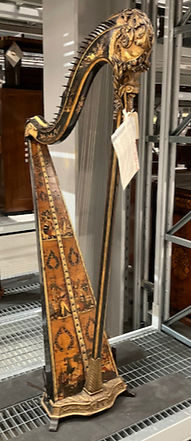
Wolters harp c1780-1785
V & A Museum, London

Pierre Krupp harp 18th Century
Courtesy of William Petit
Pierre Krupp (c 1750 – ?) was unusual amongst master luthiers in the way in which he gained his entry to the Guild of Musical Instrument Makers of Paris. Traditionally an apprenticeship had to be served during which the candidate had to be supported by family who lived in Paris, but in 1768 a royal decree established an alternative method of qualification. A craftsman who trained an orphan from the home La Trinité would become a master craftsman and his apprentice could enter the profession with the status of the son of a master. Pierre Krupp who entered the Guild in 1777 is the only harp maker known to have joined as a “Trinitaire”, by training an orphan apprentice from La Trinité.
Krupp worked in the Rue Saint-Honoré, close to the Louvre Palace and Les Tuileries from 1777 to 1791. One of his harps appears in Bruni’s list of confiscated items, it had belonged to the Count of Montmorency who lived in the Rue de Montparnasse. Montmorency was a senior army officer who fled the country in 1791.
The celebrated Russian actress and opera singer Praskovia Kovalyova-Zhemchugova (1768 – 1803) also owned a pedal harp made by Krupp, it has been described as being richly decorated with wood carving, gilding and lacquer painting. This instrument is now in the care of the Ostankino Estate Museum, Moscow and on display at the Sheremetev Palace, Museum of Music in St Petersburg.
Sébastien Renault (c 1745 – 1811) and François Chatelain (c 1745 - ?) did not disappear at the end of the eighteenth century, but they changed direction. Quite a few of their harps survive today in museums and private collections; they are beautifully carved, decorated with gilt and painted with pastoral scenes or chinoiserie. Few if any of these instruments were made after the Revolution. Around 1765 Renault and Chatelain had set up a workshop together in the Rue de Braque at the corner of Rue Ste Avoye. They made a wide variety of stringed instruments sometimes as individual makers and sometimes as partners either under the name “A la renomée” or as Renault & Chatelain. Following the revolution it seems that they abandoned harp production and only made smaller instruments such as violins, violas and lutes; labels date instruments as late as 1797 under their combined names and 1804 under Renault alone.
Some harp makers including the Cousineau family and the Naderman family survived the Revolution and flourished well into the 19th century, but their stories are for another time.

Renault et Chatelain harp soundbord
Victoria and Albert Museum, London
Sources:
Beat Wolf, The Louis XVI Harp, Harpspectrum.org (2009)
Antony Baines, Catalogue of Musical Instruments in the Victoria and Albert Museum (1998)
Orlando Figes, Natasha’s Dance A Cultural History of Russia (2002)
William Petit, williampetit.com
Askold Smirnov, The Era of Peter the great and Its Role in the Evolution of Russian Music
Tretyakov Gallery Magazine, (#2 , 2022)
Antonio Bruni, Un Inventaire sous la terreur (1791)
Prudhomme, Dictionnaire des individus envoyés à la mort judiciairement ...
pendant la Révolution (1796)
Fanny Guillaume-Castel, 'Noble throughout’
The transformations of the pedal harp in Paris and London, between 1749 and 1811
21 July 2026
A master harp maker from the Palatinate
Paris in the mid-eighteenth century was bustling with artisans and instrument makers from all over Europe, drawn to the French capital by the booming demand for luxury products and the availability of cultural patronage. Included in their number were harp makers such as Jean-Henri Naderman and Godefroi Holtzman.
Holtzman was born in the Palatinate, possibly in 1724, he became a “layetier”, a maker of precision boxes and trunks. By 1751 he had moved to Paris and had married Marie-Charlotte Duchesne, the widow of a cabinet maker. It was after this that he seems to have followed the example of his friend Jean-Henri Naderman, becoming a master luthier in 1772. The labels inside Holtzman harps are inscribed “Holtzman, Master Luthier – Maker of Harps, resides on the main Rue du Fauxbourg Saint Antoine, at the wine merchants, called The King of Siam, close to Saint Nicolas, on the second floor; he sells and supplies strings from Naples and elsewhere. In Paris.” Faubourg Saint Antoine was an area with a significant émigré population; it was famous for woodworkers, cabinet makers and other artisans who were possibly drawn by the nearby quays on the Seine where timber could be unloaded and stored.

Holtzman label
Courtesy of Rainer Thurau
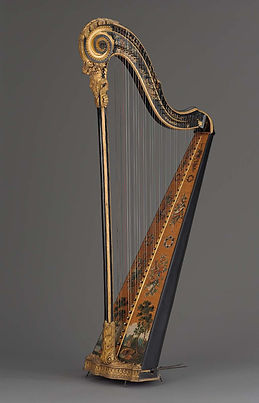
Holtzman harp c 1785
Museum of Fine Arts, Boston
In 1772 Holtzman was commissioned to make a single-action pedal harp for Madame Adélaïde, one of the daughters of Louis XV, this level of patronage must have firmly established him as a supplier to the aristocracy. Holtzman’s harps were highly prized and he continued to make instruments until shortly before his death in 1792. An inventory of musical instruments confiscated from the houses of French nobility in the early years of the Revolution detailed two Holtzman harps, one at the home of the Comte de Vergennes in Rue des Petits Augustins, the count who had been Foreign Minister to Louis XVI had died in 1787. The other was at the home of the Vicomtesse de Jaucourt a prominent noblewoman, prior to the Revolution she had owned houses in both Rue de Babylone and Rue de Grennell St Germaine, but in later life she fell into impoverished obscurity. One further purchaser of a Holtzman harp was Eliza de Feuillide, cousin and later sister-in law to the novelist Jane Austen.
Godefroi and Marie-Charlotte had three children who remained associated with the luthier business; their sons Henri and Jean-Baptiste both became harp makers and their daughter also called Marie-Charlotte married the luthier and harpsichord maker Jean Busch. Few of any of their harps remain today.
Incidentally, the Rue de Faubourg Saint Antoine ran eastwards from the Bastille prison. It was an area well known for social unrest and became the epicentre of the French Revolution in Paris with the storming of the fortress on 14th July 1789. It would be fascinating to know what Holtzman had witnessed.

Location of the Holtzman workshop.
Jean Lattre, Plan de la Ville de Paris 1783
Sources:
Mike Parker
Gabriella Dall'Olio, Trinity Laban Conservatoire
Wanda Savage
Antonio Bruni: Un Inventaire sous la terreur (1791)
12 July 2026
Music printing in the past
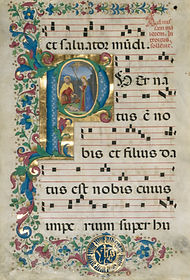
From the time that it became possible for music to be written (see "The Development of Music Notation in Western Europe", 26 May 2026) it also became desirable for reproductions to be made. Originally, handwritten copies would have been produced on vellum by scribes in the monasteries or courts where the music was used. These highly skilled craftsmen created beautiful reproductions, the staves were typically drawn in red ink and the notes added in black, the pages were richly decorated with brightly coloured intricate designs often including gold or silver leaf which made the text shine and gave rise to the term “illuminated manuscripts”. The pages were often stunning but the process was labour intensive and time consuming.
.jpeg)
Leaf from a Gradual c1500
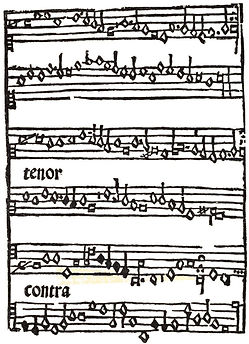
Extract from Opusculum Musices
by Nicolaus Burtius
Throughout the early 15th century printers developed a process involving woodblocks in which the notes and staves were carved in relief onto blocks of wood. This method of printing had been in use in China since antiquity but had only appeared in Europe in the 14th century as a means of printing text and later music.
The woodcutter would first draw or write the music in reverse on a levelled piece of wood. He then had to carve away the spaces between the musical symbols to leave elevated notation. Once complete the woodblock would be inked and pressed on paper or vellum. The quality of the music produced depended on the skill and carefulness of the woodcutter. The earliest known music created by woodblock printing is Opusculum Musices by Nicolaus Burtius, it was printed in 1487 in Bologna, Italy.
Around 1450 Gutenberg invented the movable-type printing press which allowed mass production of written text; within 50 years movable-type was also being used to produce music. Probably the first to print polyphonic music was the Italian printer, Ottaviano Petrucci, who between 1501 and 1520 produced 61 books of masses, motets, madrigal collections and music for lutes. The process which Petrucci developed involved three successive steps printing first the staves, followed by the notes and the text. Although the copy produced was clean and elegant it was a slow process which required great skill.

Extract from a Petrucci score c1506

Example of movable-type printed music and forme comprised of individual type blocks
A little later in 1520s England John Rastell had created a different system in which the movable-type included staves and words together on individual pieces of type. The type formes would be arranged rather like a jigsaw or mosaic in order to print staves, music and text in a single run. Although this produced less elegant music than Petrucci’s method the process was faster and following it’s adoption by the French printer Pierre Attaignant it became widespread throughout Europe.
As polyphonic music became more elaborate movable-type printing proved to be inadequate to accurately represent a composers intentions. Printers moved to a process in which music was engraved by hand onto a flat metal surface such as copper or pewter. Beginning with the staves the engraver would draw a sketch of the music in reverse, once satisfied with the layout the lines, notes and notations would be cut or “graved” onto the metal surface with a variety of tools and punches. The surface would then be polished to remove debris and ink would be forced into the engraved areas to be printed onto paper.

Music printers used engraving for over two hundred years from the late sixteenth century onwards, in fact the German publisher G Henle Verlag continued to engrave music by hand until the year 2000. But with rapid advances in technology the method was gradually displaced first by lithography, then photography, musical type-writers and ultimately computer programs.
Sources:
musicprintinghistory.org
Groves Dictionary of Music and Musicians
Cleveland Museum of Art
29 June 2026
The Stradivari of hurdy-gurdy makers
As is often the case Jean Louvet, an instrument maker probably from Normandy, passed on his skills to his sons Pierre and Jean (le jeune) Louvet. The brothers, who made a wide variety of stringed instruments were both working in Paris from around 1730 to the early 1780s. They were highly skilled and were renowned for their instruments during their life-times; because of the elegance of their workmanship and the quality of the instruments they produced since their deaths they have become known as the “Stradivari of the hurdy-gurdy” .

Jean Louvet harp 1765 soundboard detail.
Rainer Thurau
The brothers were amongst the earliest artisans to turn their attention to making pedal harps. Jean (le jeune) Louvet (1718 – 1793) became a master instrument maker in 1743 and a sworn master of the Luthier Guild in 1759. Louvet’s older brother Pierre (1709 – 1784) was already a sworn guild master by 1742, he became Dean of the Luthiers Guild in the 1770s which position he held until his death.
Few harps or other instruments by either of the Louvet brothers survive today, but those that can be found demonstrate the beautiful artistry and skill of their makers.
Pierre Louvet Hurdy Gurdy c1750
Victoria and Albert Museum, London

By the early 1750s Pierre and Jean Louvet had established a workshop close to the Louvre Palace in Paris, making harps as well as hurdy-gurdies, bagpipes and violins. Labels in their instruments give their address as La Vielle Royale, Rue de la Croix-des-Petits-Champs a cote de la Porte Saint Honoré, which probably refers to the entrance of the monastery of Saint Honoré which was located at the southern end of the Rue de la Croix-des-Petits-Champs. This must have been a prestigious environment for these eminent artisans.
Sources:
Almanach Musical 1779 and 1783
Philharmonie de Paris, harp glossary
Victoria and Albert Museum Catalogue of Instruments
Amati Auctions

Location of the Louvet workshop.
Jean Lattre, Plan de la Ville de Paris 1783
18 June 2026
Towards double-action
The marvel of the single-action pedal harp was the ease with which each string could be adjusted to play two adjacent semitone notes. To allow the harp to be played in the largest number of key signatures single-action harps were tuned in Eb major. By engaging successive pedals the key of the instrument could be moved from Eb to Bb, F, C, G, D, A and E major scales with most of the associated minor keys. But a keyboard instrument such as a harpsichord or fortepiano could play in twenty four different major and minor keys which made the harp appear rather limited. The primary objective of progressive harp makers in late eighteenth century Europe was to develop a way to sound three notes on each string, thereby increasing the modular versatility of the instrument.
Georges Cousineau was born in western France in 1733. At some stage he moved to Paris where he was raised by relatives who worked as instrument makers, notably Jean Ouvard and Jean-Baptiste Deshaye Salomon (see "Who made single-action harps", 16 May 2026). In 1758 he became a master artisan and established his own workshop where he made a wide variety of instruments including single-action harps. Cousineau was a consummate innovator, he considered changing the shape of the soundbox and attempted a system for turning the tuning pins when a pedal was engaged. Probably his most famous invention was his trademark béquilles mechanism which became popular throughout Paris from 1780 (see "The advent of the single-action harp", 22 April 2026). But Cousineau had also turned his attention to the three note issue.
Cousineau 14 pedal harp, private collection
Photo by Robert Adelson

Sketch from 1782 presentation to the Académie des Sciences
Photo by Fanny Guillaume-Castel
In 1782 Georges Cousineau presented a report to the Académie des Sciences describing his latest development: a fourteen pedal harp. The addition of a second pedal for each note and second pair of béquilles on each string allowed three notes to sound on every string. This harp would have the same versatility as a harpsichord. Like a modern double-action pedal harp, the fourteen pedal harp was tuned in Cb major with no pedals depressed. Engaging the bottom pedal raised the pitch of the strings by one semitone and subsequently engaging the top string increased the pitch again. However, if only the upper pedal was used the pitch of the string would rise one whole tone.
It is not known how many of these harps Cousineau made, there are few contemporary reports but some suggest that the mechanism was fragile and overly complicated to maintain, the number of pedals daunted the beginner and even that the increased weight was a disadvantage. It seems likely that the instrument was only produced for a few years in pre-revolutionary France. Only one instrument is thought to survive today, it has 37 strings and is of similar size and shape to other Cousineau harps of the time. The harp is known to have been acquired by Sébastien Erard sometime between 1796 and 1815, and is now held in a private collection.
Sources:
Adelson, Roudier and Duvernay.
Rediscovering Cousieau's Fourteen-Pedal Harp
Fanny Guillaume-Castel, 'Noble throughout’
The transformations of the pedal harp in Paris and London, between 1749 and 1811
Robert Adelson. Originality and Influence:
Charles Gröll's Role in the Invention of the Double-Action Harp

Cousineau 14 pedal harp, private collection
Photo by Robert Adelson
7 June 2026
The Development of Music Notation in Western Europe
“Sounds perish if they are not remembered by human beings, because they cannot be written down”
Translation from Etymologiae by Isidore of Seville, an early seventh century scholar.
Isidore recognised the key problem of early music: tunes were passed from one generation to the next by ear, every reiteration subtly changing what was originally intended, with no means to write the music melodies could not be accurately preserved.
The way in which we write music today did not suddenly spring into existence but gradually evolved over many centuries. In Western Europe the first people to annotate words in order to indicate melody and rhythm were monks. They used marks called neumes above the syllables of the words to indicate how the chant should be sung. This later evolved into a system in which the neumes were spaced in a way which would indicate the general shape of the music and the duration of each note. Neumes probably provided a useful memory aid for those who already knew the music but they may have been less helpful to those trying to learn the music.

Jubilate Deo chant marked with neumes
The next step change in music notation is generally attributed to Guido d’Arezzo, a Benedictine monk living in the early eleventh century. D’Arezzo is credited with introducing a four line stave on which notes could be placed to allow singers to ‘read’ the pitch intended, one line being marked to indicate the key in which the chant was based. Guido D’Arezzo also introduced a means to remember the relative pitches of notes using an eighth century chant "Ut queant laxis", the Hymn to St John, .

The first notes of the first six lines rise in pitch according to a major scale, Guido d’Arezzo used this to name the notes of the scale Ut, Re, Mi, Fa, Sol, La. This allowed singers to learn new music more easily by using relative pitch in a standard major scale. This method of notation known as solfège is still in use today although in some languages Ut has been replaced by Do.
It would be more than 200 years later, around 1250 when Franco of Cologne introduced a representation which allowed musicians to read the duration of the note as well as the pitch. These marks were mostly square or diamond shaped black note heads with no stems. They represented notes which we now call breves and semi breves and two longer notes called longa and maxima. Within the next hundred years white notes and stems were being used creating the concept of minims and crotchets.
With the development of polyphony in both sacred and secular music a wider variety of note lengths were needed. By the 16th century more depictions of notes were in use with flags being used to create quavers and semi-quavers.

Celeste Beneficium by Jean Mouton
From The Spy's Choirbook, Early 16th century,
British Library
In addition the note shapes had become rounded, time signatures and bar lines were all in use and a fifth line had appeared on the stave. Although the development of musical notation had originally been driven by singers by the 17th century instrumental music was becoming more prominent and instrumentalists accordingly adopted stave notation as well.
However, there was one notable exception which was the music written for lutes and similar instruments. Composers and musicians used a system called tablature which was based on the use of the frets on the neck of the instrument. During the Spanish Renaissance music for vihuela, keyboard and harp which were generally interchangeable at this time were written using tablature. The horizontal lines on the page represented the strings of the vihuela and the numbers represented the note to be played. In general the lowest string was written on the top of the stave and the highest string at the bottom this would have best suited a right handed vihuela player, but this order could be reversed if the piece was intended for keyboard or harp rather than guitar. The published music of Cabezón was written in this way (see “The Blind Spanish Harpist” 18 February 2026).
24 May 2026
Who made single-action harps?
The single-action pedal harp created by Jakob Hochbrucker, was displayed and demonstrated across Europe by his sons and his nephew throughout the early and mid-eighteenth century. The instrument became popular and was readily copied, particularly in France where Parisian instrument makers adopted the concept and made it their own. By the second half of the century the Louis XVI style single-action pedal harp was dominating the French musical scene.
The Louis XVI harps were a little taller than the Hochbrucker harp and more elegant. Their most distinguishing feature was the scroll at the head of their pillar, the sound boards were painted with landscapes, floral decorations and sometimes chinoiserie. They predominantly used the crotchet mechanism possibly developed by the German player G. A. Goepfert.
But who was making these harps?


Louis XVI harp attributed to Cousineau at the Historisches Museum Basel. The harp has the distinctive scroll and painted soundboard.
Probably the earliest surviving harp from this era was discovered in a skip in Dijon in 2022. Restoration of the instrument revealed an inscription inside the harp reading “Salomon à Paris”. Believed to have been made around 1755 it has the scroll and shape typical of Louis XVI style but its mechanism is similar to the crutch device used by Hochbrucker. Jean-Baptiste Deshayes Salomon (1713-1767) was a luthier making and selling a wide range of string instruments, a surviving business card includes harps in the list of instruments he sold and on his death his estate listed several harps including two ready to be fitted with a mechanism. However, the Dijon instrument is the only Salomon harp known to exist today.
Another early maker was Edmond Saunier (1730 – 1783), born in eastern France near Nancy he established himself as a distinguished mandolin maker in Bordeaux before moving to Paris around 1766. An elegant harp made by Saunier probably around 1760 is held by the Musée de la Musique, Paris, it uses crotchets to change pitch. A second instrument is known to exist at the Scenkonstmuseet in Stockholm.
Details of makers from later in the century are recorded in the Almanach Musical, a yearly directory concerning musical events, teachers and instrument makers in Paris. In the 1783 edition harp makers were listed as a distinct category for the first time, sixteen makers were named. Some such as Naderman and Cousineau would continue for many years making instruments that would survive to the present day, others such as Laurent, Vanderlist, Guillaume and Godelard would thrive for a short time but none of their harps survive today.
Sources:
Beat Wolf, The Louis XVI Harp, Harpspectrum.org‘
Fanny Guillaume-Castel, 'Noble throughout’
The transformations of the pedal harp in Paris and London, between 1749 and 1811
Almanach Musical, Paris 1783


Extract from the Almanach Musical 1783
16 May 2026
Harp music in eighteenth century Europe
Probably the two most familiar pieces of harp music written in the 18th century are the Concerto in B-flat major op. 4, no.6 by Handel and the Flute and Harp Concerto in C major K299 by Mozart. These two pieces composed forty years apart were written for two very different instruments and demonstrate the progress from late baroque to early classical style.
Handel’s Harp Concerto, formed part of the ode "Alexander’s Feast, or the Power of Music", which was first performed in 1738. It was played following the recitative “Timotheus placed on high” which praises the ancient Greek singer Timotheus and his harp. The concerto was written for William Powell, a Welsh harpist, who Handel had probably first met whilst he was composer in residence to the Duke of Chandos around 1718. Powell was a prominent, virtuoso performer who became harper to the Prince of Wales in 1736 at which time it has been suggested he may have acquired the beautiful David Evans harp now in the care of the Victoria and Albert Museum (see 15 April 2026). The concerto which is intricate with fast passages of changing tonality, was written for the triple harp.
.jpeg)
David Evans triple harp 1736
Victoria and Albert Museum London

Single-action pedal harp Paris c1780 unknown maker
Victoria and Albert Museum, London
In contrast Mozart’s Flute and Harp Concerto was composed for a single-action pedal harp. It was commissioned by Adrien-Louis de Bonnières, duc de Guînes, in Paris in 1778. De Guînes was a flautist whose daughter, Marie-Louise-Philippine de Bonnières, was a harpist who was taking composition lessons with the composer. Mozart apparently thought well of both instrumentalists as players but did not think highly of the young woman’s composing skills. Ultimately the relationship soured, De Guînes failed to pay for the concerto and offered only half the fee due for the composition lessons.
But Handel and Mozart were not the only composers writing for the harp in the eighteenth century. Across Europe the single-action pedal harp was becoming increasingly popular in the salons of the wealthy and music ranging from solo instrumental work, chamber music and concertos was being provided by a host of composers who travelled and worked widely. Although many of their names are no longer familiar their work is still in the canon of both students and performers.
Austrian composers who wrote for the harp in this era included Johann Albrechtsberger, Carl Ditters von Dittersdorf, Joseph Haydn and Georg Christoph Wagenseil who taught harpsichord, though not harp, to Marie Antoinette. Germany could boast CPE Bach, Johann Hertel, Francesco Petrini, Johann Schroeter and Ernst Eichner while France produced composers such as Francois-Adrien Boieldieu and Joseph Bologne, Chevalier de Saint-Georges.
Bohemia was the birth place of Jean-Baptiste Krumpholz and Jan Ladislav Dussek. Krumpholz worked with French harp makers to help them develop and improve their instruments, his second wife was the French harpist and composer Anne-Marie Krumpholz (née Steckler). Dussek also married a composer, the Scottish harpist Sophia Corri. Both Krumpholz and Dussek led interesting lives which were somewhat entwined but that is probably best kept for another time.
Sources:
Andrewlawrenceking.com/2014/03/12/the-triple-or-modern-welsh-harp/
Guido Fischer, Album notes for Xavier de Maistre cd "Händel"
4 May 2026
John Egan, Harp Maker to King George IV and the Royal Family
The development of pedal harps during the eighteenth century caught the imagination of one inspirational Irish harp maker. John Egan, a blacksmith’s apprentice from Dublin was captivated by a chance encounter with a pedal harp and following intense study of the mechanism decided to begin making instruments himself. By the early nineteenth century Egan’s elegant and richly decorated Grecian style pedal harps adorned the drawing rooms of the Anglo-Irish aristocracy in Dublin and beyond.
By the early 1800s use of the traditional wire strung Irish harp was dying out. Egan realised that the mechanism used in the pedal harp could be adapted to develop a small gut strung chromatic harp in the style of the traditional Irish harp. Pedals would obviously not work on a small harp so he produced an instrument in which the mechanism within the column and neck of the harp was controlled by small buttons or ditals mounted on the pillar. Moving any single dital would cause fourchettes to rotate and engage all the strings of one note to change pitch. This allowed changes in key across the whole instrument.

John Egan Pedal Harp
Courtesy of Lisburn Museum, Northern Ireland

John Egan Royal Portable Harp
Victoria and Albert Museum, London
Egan’s instrument was called the Royal Portable Harp, it was the same shape as a traditional Irish harp though considerably smaller but it had the flexibility of the modern pedal harp. The portable harp was popular with society ladies particularly after Egan was granted a royal warrant by King George IV in 1821 allowing him to style himself “Harp Maker to King George IV and the Royal Family”. A notable portrait painted by Sir Thomas Lawrence in 1822 depicts Lady Elizabeth Conyngham, the daughter of the mistress of George IV, tuning her Egan harp. Although fashionable during the first half of the nineteenth century the portable harp gradually diminished in popularity as musical tastes changed and the wealth of Irish society declined.
Over a career spanning nearly 40 years John Egan made around 2000 harps, mostly from his workshop at 30 Dawson Street, Dublin. It is thought that less than 40 survive today.
Sources:
Lisburn Museum
Gabriella Dall’Olio, Trinity Laban Conservatoire
Nancy Hurrell, The Egan Irish Harps
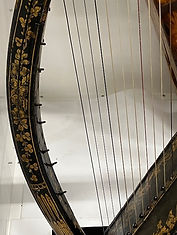
Detail of ditals
.jpeg)
Name plate and fourchettes

29 April 2026
The advent of the single-action harp
In the early eighteenth century a new mechanism was devised to allow harpists to play chromatic music. Metal hooks which increased the pitch of a string were already in use but they were not necessarily used on all strings and they had to be turned individually by hand. The Bavarian Jacob Hochbrucker (also known as Jakob Hochprugger) is generally credited with inventing a new system that allowed the pitch of multiple strings on a harp to be changed at the same time, this eventually became known as the single-action harp.
Jacob Hochbrucker was thought to have been born in Mindelheim, Bavaria in 1673; from around 1699 he lived and worked in Donauwörth as an instrument maker. In 1720 he introduced a pedal mechanism to harps which would revolutionise the way in which harps could be played. Pedals located in the base of the instrument were connected by a series of rods and linkages which ran up the pillar and along the neck to hooks which shortened the strings to create a note one semitone above the natural pitch of the string. The pedals were operated by the players feet and when one pedal was engaged every string of one particular note in the instrument would change pitch. While Hochbrucker’s instrument had a pedal for each note in the octave some other makers produced harps with fewer pedals. With the harp being tuned in E flat harpists could now play in a vast range of keys in an uncomplicated manner.
Hochbrucker’s son and nephews travelled across Europe promoting the harp which rapidly grew in popularity. When Marie Antoinette arrived at the French court in 1770 she took up the instrument making it highly fashionable with French aristocracy. By this stage various other harp makers were also creating pedal harps making exquisitely decorated instruments and introducing various modifications to the mechanism.

Reproduction of a Hochbrucker harp by Rainer Thurau
The method used by Hochbrucker to shorten the string was a crutch which was fitted to the neck of the instrument adjacent to every string. When a pedal was depressed the crutch turned and pushed the string towards a pin to shorten the string and thus alter the pitch.
In one variation on this method a flag like device called a crotchet pulled the string toward a bar on the neck of the harp having the same effect as a violin player putting a finger on a string to shorten it and produce a higher note. These mechanisms remained in use for around 60 years with only minor changes, it was only towards the end of the 1700s that significant alternatives began to be introduced.

Renault-Chatelain crotchet mechanism

Cousineau béquilles mechanism
One such alternative was the béquille mechanism used by the harp maker Cousineau from around 1780. This device involved two levers either side of a string, when a pedal was pressed the levers turned so that the string was gripped tightly between the two. This was said to be more reliable than the crotchet mechanism but the strings had a tendency to vibrate against the levers causing them to buzz.
In 1794 Sébastien Erard patented the fourchette mechanism which involved a single rotating disc with two prongs or forks. The string ran between the two prongs and when a pedal was depressed the disc rotated pressing against either side of the string to increase the pitch without affecting its alignment or changing the quality of the note produced. Over time the fourchette gradually became the standard mechanism.

Erard fourchette mechanism
In the early nineteenth century further developments would be made which would allow the pitch of a string to be changed twice using a single pedal. Harps with the new type of mechanism would be called double-action harps.
Schematic diagrams of single action mechanisms

Original Hochbrucker

Crotchet mechanism

Béquille mechanism

Erard fourchette
Sources:
Beat Wolf, The Louis XVI Harp, Harpspectrum.org
Mike Baldwin and Lewis Jones, The Hochbrucker Family
and the Adoption of the Pedal Harp before 1760, AMIS 2022
Ann Fierens
Rainer Thurau
22 April 2026
A trio of triple harp makers
Once the triple harp had been introduced to the English court in the 1600s it quickly became popular both in England and Wales. In the 18th and 19th centuries there were a number of noted harp makers in the British Isles including David Evans of Covent Garden, John Richards of Llanrwst and Bassett Jones of Cardiff, some of their instruments survive and can be seen in museums around the world.
One of the earliest surviving triple harps in England is held by the Victoria and Albert Museum. It is a richly decorated instrument and is marked “David Evans Instrument Maker, In Rose Court, near Rose Street, Covent Garden, London 1736”. Little is known about Evans, but it is possible that he was the same David Evans who was employed as harpist to George III. It is also possible that William Hogarth used one of Evans’ harps as a model for the instrument pictured in the engraving of the scene from The Rake’s Progress which shows the protagonist, Tom Rakewell, at the Rose Tavern in Covent Garden (1735).
John Richards of Llanrwst was one of the best known triple harp makers in Wales during the 1700s. He was born in 1711 and in 1755 he was commissioned to build a harp for the celebrated harpist John Parry. For a time, Richards was living in London as harpist to Queen Charlotte and was a friend of George Frederick Handel. In 1759 Richards returned to Wales where he continued to make harps, he died in 1789. An image of a John Richards harp is shown in the article below (7 April 2026).


Above: harp from the back
Side: harp sound board
David Evans 1736
Victoria and Albert Museum, London
.jpeg)
Bassett Jones harp for The Great Exhibition, 1851
By permission of Amgueddfa Cymru – Museum Wales.
By the mid-nineteenth century the pre-eminent maker of the triple harp in Wales was Bassett Jones. Born in 1809 at St Nicholas, Glamorganshire, as a young man Bassett Jones worked in Cardiff as a wheelwright. But by the 1830s he had become a recognised maker of Welsh harps. In 1834 an Eisteddfod was held at Abergavenny, this was a competitive festival of music and poetry organised to promote Welsh culture. It had been suggested that a harp to the value of 20 guineas should be given to the winner. Bassett Jones was commissioned to build this prize harp, which he did so from detailed drawings of a John Richards instrument. He went on to become the official harp maker to future Eisteddfodau making prize harps for the competition winners for some years.
In 1843 Bassett Jones built a harp to be presented to the infant Prince of Wales, who later became King Edward VII and subsequently he went on to be named “First maker of triple harps to Queen Victoria and Prince Albert”. There followed a request to make a harp for The Great Exhibition of 1851, the Queen suggesting that the “artistic or ornamental part of the instrument will be emblematical of the Cymry, and the design and exquisite workmanship are intended to surpass anything of the kind hitherto manufactured at Mr. Jones’s establishment”. This beautiful instrument is adorned with dragons at its feet, a leek at the base of the column and fleur de lys feathers in a coronet at the crown with intricate gold leaf decoration of flora and fauna across the soundboard. The Great Exhibition harp is now held at St Fagans National Museum of History, Wales.
The use and making of triple harps within the United Kingdom flourished until the end of the nineteenth century. But the gradual move towards larger orchestral instruments led to a decline in the traditional Welsh harp. The early music revival of the mid twentieth century brought about renewed interest in older styles of harps with several craftspeople around the world now making triple harps and other “traditional” instruments.
Sources:
Andrewlawrenceking.com/2014/03/12/the-triple-or-modern-welsh-harp/
Kathryn Leigh Hockenbury, The triple harps of Bassett Jones (1809-1869): Context and Organology
Anthony Baines, Catalogue of Musical Instruments in the Victoria and Albert Museum
15 April 2026
Why are bass strings so long?
Or put another way why are harp strings such varied shapes and sizes?
If you look at any harp you immediately see that the high notes are produced by short strings whereas the deep notes are produced by long strings. When you tune your harp you tighten the strings, or increase the tension, to raise the pitch. Look at your harp a bit more closely and you will see how the strings gradually become thicker as the notes get deeper. This means that the mass per unit length of the string is increasing as the notes get deeper.
The change in length and thickness of the strings is easy to see but the tension may seem a bit more obscure. Try plucking one of the bass notes on your harp and you may well see it moving because the tension is lower than in the higher strings, this is particularly visible on the deep metal strings on a pedal harp.
All these factors affect the pitch of the note, they are connected by the String Frequency Equation.
The pitch of a note is determined by the frequency with which air vibrates, in a stringed instrument such as the harp this is the frequency at which the string vibrates. The String Frequency Equation connects that frequency produced (f) to the length (L), tension (T) and the mass per unit length (µ). The equation is written as:

John Richards triple harp c1750
Metropolitan Museum of Art, New York

In words this equation says that frequency increases when the tension in the string goes up and when the length of the string and the mass per unit length go down. Or more simply a short, tight, thin string produces a high frequency note and a long, dense, loose string produces a low frequency note.
7 April 2026
Chromaticism in Italy
While Spanish harpists were developing chromatic harps with two rows of intersecting strings (see 10 February 2026), Italian harp makers gradually moved towards three sets of parallel strings. The outer two courses which were tuned in unison being the diatonic notes and the inner course, which could be played by either hand, being the semitone notes. The harps were called arpa doppia.

Barberini triple harp
Museo nazionale degli Strumenti Musicali, Rome
Very few original Italian instruments survive although the Barberini harp which dates from around 1605 to 1620 can be found in the Museo Nazionale degli Strumenti Musicali in Rome. This harp also appears in a famous painting from 1632 “Allegoria della Musica” or “Venus playing the harp” by Giovanni Lanfranco. Another triple harp from the early seventeenth century is featured in Domenichino’s “King David Playing the Harp” from 1619, this painting clearly shows the three courses of strings on the instrument. Both of these harps have relatively narrow soundboards which would have limited the sound produced.

King David Playing the Harp
Domenichino
A much broader instrument was made by Giovanni Vettorazzo from Vicenza, in 1793 this can be found at the Grassi Museum für Musikinstrumente der Universität Leipzig in Germany.
The triple harp was brought to London during the seventeenth century by the French player Jean le Fielle who was in the entourage of Henrietta Maria of France when she became the queen of Charles I. It was quickly adopted by Welsh musicians in London and in Wales who appreciated its intricacy and found the instrument suited the Welsh style of playing. On the restoration of the monarchy in 1660 a Welsh player named Charles Evans was appointed to the court of King Charles II with the title “His Majesty’s harper for the Italian harp”.
Use of the triple harp gradually diminished in continental Europe after the introduction of the pedal harp in the mid eighteenth century but maintained its popularity in Wales and subsequently became known as the Welsh Harp. In the British Isles there were a number of renowned harpists such as John Parry and Edward Jones. Composers continued to write for the triple harp well into the 1700s, one of the most famous pieces being the Concerto for Harp by G F Handel which first appeared in 1738.

Giovanni Vettorazzo Harp
Graasi Museum fürMusikinstrumente der Universität Leipzig
31 March 2026
Turlough O’Carolan
(born 1670 died 25 March 1738)
To mark the anniversary of his death, Rupert is looking at the life of the blind Irish harpist Carolan.
Turlough O’Carolan, often simply referred to as Carolan, was an Irish harper, singer and composer. He was born in 1670 in County Meath where his father was a blacksmith, but later the family moved to County Roscommon in Connacht. Carolan was educated by a benefactor and when he was blinded by smallpox at the age of eighteen he was apprenticed to a harpist.
O’Carolan became an accomplished harper, for more than fifty years he travelled throughout Ireland with a horse and a guide performing and composing at the great houses of the land. It was a time when harpers were highly respected within the community and Carolan would have been welcomed as an honoured guest. Many of his works were “planxties” which are pieces dedicated to a particular wealthy patron. A small number of his works were published during his lifetime in 1724 in a compilation entitled “A Collection of the Most Celebrated Irish Tunes” by John and William Neal instrument makers from Dublin. A comprehensive collection of more than 200 tunes was published in 1958 by Donal O’Sullivan.

Carolan's harp
National Museum of Ireland


Carolan played a traditional Irish harp with metal strings which were plucked by finger nails (see 13 November 2025). A harp believed to belong to him is held at the National Museum of Ireland in Dublin.
O’Carolan wrote songs in Gaelic but few copies of his lyrics survive. Today he is best known for pieces such as Carolan’s Concerto, Planxty Johnston and Madam Cole. Recordings of these pieces can be found on Katie’s YouTube channel Cornishharp.
Carolan is now regarded as Ireland’s most famous composer, monuments to him have been erected, parks are named after him and his image appeared on the Irish £50 note. He is also remembered in St Patrick’s Cathedral Dublin with a marble memorial stone.
24 March 2026
St Patrick's Day
The harp in Irish coinage
St Patrick is the patron saint of Ireland, he is remembered in Irish communities around the world on 17th March. Patrick is not known to have had any connection with the harp, but harps are ubiquitous around Ireland, not only as musical instruments but appearing as symbols of the Irish identity on logos, Irish passports and also money.
Since the time of King John, around 1200 AD, a succession of English kings introduced various coins into Ireland. These were initially pennies, half-pennies and farthings but in the mid-1400s Edward IV introduced higher value coins called groats which were worth four pence or a third of a shilling. The coins were typically hammered with an image of the king on one face and either a crown or cross on the reverse or obverse side.

1942 Irish half crown

Tudor Irish harp Groat
In sixteenth century Ireland harpers were considered to be high status musicians and the harp was regarded as probably the most important instrument in Gaelic society. The harp came to symbolise the culture and identity of the Kingdom of Ireland. So much so that when King Henry VIII introduced new coinage in around 1534 the groats and half-groats carried for the first time the harp as the symbol of Ireland on the reverse face. These coins became known as “harp groats”. Later Queen Mary I and Queen Elizabeth I went on to issue shillings bearing harps on the reverse side which were called “harp shillings”. Apart from periods when the crown was in dispute during the mid- and late-1600s, Irish coinage has continued to carry the image of a harp on one side from that time to the present day.
17 March 2026
Rose Adélaïde Ducreux
To celebrate International Women's Day Rupert decided to look at a wonderful self-portrait by an eighteenth century artist and harpist.
Rose-Adélaïde Ducreux was born in Paris in 1761, the eldest child of the artist Joseph Ducreux. She learnt to paint in her father’s studio and exhibited in public for the first time in 1786. She remained in Paris throughout the turmoil of the French Revolution exhibiting at the Louvre Salon in 1791, 1793, 1795, 1798 and 1799. Ducreux never signed her work with the result that most has not been identified. In 1801 she went to Saint-Domingue (now known as Haiti) to marry a maritime prefect, but she quickly contracted yellow fever and died in July 1802
.jpeg)
Self-portait Rose-Aldélaïde Ducreux
Metropolitan Museum of Art, New York
It was not unusual for women artists at this time to include artefacts which highlighted their accomplishments in their self-portraits. In this picture, first exhibited in 1791, Ducreux advertises her skill as an artist and also as a musician, she is portrayed as being totally at ease with her instrument the harp. She is believed to have been both a harpist and a composer though none of her works survive.
The detail on the instrument clearly suggests a harpists knowledge. It is a single action pedal harp, possibly made by Georges Cousineau, it is very similar to an instrument by the same maker in the Historisches Museum Basel. The strings are beautifully delineated even to the detail of showing red coloured C and dark coloured F strings. While Ducruex plucks a string with her left hand she holds a tuning key in her right. The music behind the instrument is a clearly depicted song perhaps suggesting that she sang to her own accompaniment.

Source: Harp Art by Tim Stuart, We Do Music, 2007
8 March 2026
St Piran's Day
St Piran is the patron saint of Cornwall and its tin miners, every year the Cornish celebrate St Piran's Day on the 5th March. Rupert has spent much of his life in Cornwall and he thought it would be interesting to explore St Piran's connection with harps and harpists.
.jpeg)
As a young man Piran was priest and counsellor to King Aengus of Munster, Ireland. Legend has it that the king being fond of music had in his court seven harpists who would play and sing for him. One stormy day the harpists drowned in a dangerous bog and all that could be found of them was their harps. St Piran hung the harps on trees beside the bog so that their music could still be heard as the wind moved through the strings. He then prayed for three days and three nights and finally the harpers were brought back to life.
Later Piran fell foul of the king who had him cast into the sea tied to a millstone. But luckily the saint was freed of his bonds and the millstone floated on the water until it was washed up at Perranporth on the north coast of Cornwall. Apparently St Piran also discovered how to smelt silver coloured tin from its black ore giving rise to the colours of the Cornish flag.
5 March 2026
The Blind Spanish Harpist
Harpists frequently find themselves playing music by Cabezón, who is often mentioned simply as a blind Spanish composer. But this is a rather narrow description of an incredibly talented man.
Antonio de Cabezón (or Cabreçon) was born near Burgos in northern Spain in 1510, nothing is known of his early life except that he became blind as a young child. He grew up in the early years of Spain’s Golden Age after the Catholic monarchs had finally conquered the southern part of the country. This was a period when music and the arts flourished and a distinctive Spanish style evolved.
In 1526 Cabezón entered the royal household being employed by Isabella of Portugal, the consort of Charles V of Spain, to play the clavichord and organ. In due course he also taught Isabella’s children including Prince Felipe. In 1543 Felipe became regent of Spain and Cabezón was appointed court organist. Antonio and his brother Juan, who was also a court musician, travelled extensively with Felipe when he visited Italy, the Netherlands, Germany and England, where Felipe or Philip married the Tudor queen Mary. Cabezón was still employed by the king when he died in Madrid in 1566.

During his lifetime Cabezón composed hundreds of pieces of music which probably could have been played on a variety of instruments, including dance and chamber music, liturgical music such as hymns, Magnificats, Kyrie arrangements and possibly a mass which is now lost. Some of Cabezón's work was published in his lifetime most notably in a collection called Libro De Cifra Nueva para tecla, harpa, y vihuela which was produced by Luis Venegas de Henestrosa in 1557. The Pavane and Variations which occurs on the ABRSM exam syllabus is included in that collection. One of Cabezón's five children, Hernando de Cabezón, was responsible for the posthumous publication in 1578 of more of his father’s work in a volume called “Obras de música para tecla, arpa y vilhuela” (Works for keyboard, harp and vihuela).

The Pavane by Cabezón as written in 1557. Rupert will have a look at the changes in music notation at a later date.
Source – Cabezón family by Louis Jambou, Grove Music Online
18 February 2026
Early Spanish Chromatic Harps
Early modern times brought many changes to all forms of art, literature and music across Europe. In music compositions became increasingly chromatic and it became clear to some harp players and instrument makers that the traditional diatonic harp which was tuned in a single key was not well suited to the compositions of the sixteenth century.
There were ways to play chromatic sequences on the harp but they were not straight forward. Skilful players such as Ludovico who was harpist to Ferdinand, King of Aragon was said to be able to shorten the length of a string to sharpen a note by pressing it against the neck of the harp, a bit like a lever on a modern harp. Another common method called scordatura involved retuning individual strings to change to tonality of the instrument in different octaves. But neither of these techniques were adequate to deal with range of music which was becoming popular.
Spanish instrument makers were the first to develop a chromatic harp, this was a double harp with two rows of strings which probably intersected between the soundboard and the neck without touching. One row of strings, contained the diatonic notes (like the white keys on the piano) and the other row had the accidentals (like the black keys).

Ribayas harp by Rainer Thurau

Detail of the Ribayas harp by Rainer Thurau
It is thought that this form of harp, the “arpa de dos ordenes”, was invented by Juan de Carrión an instrument maker, probably from Madrid, who worked in the second half of the 1500s. A further improvement was made around 1555 by Juan Bermudo a Franciscan Friar who introduced red strings to distinguish the chromatic from the diatonic notes. These developments both resulted from and contributed to the period known as Spain’s Golden Age, but more of that another time.
The instrument pictured here is the Ribayas harp made by Rainer Thurau, it is a recreation of a small Spanish chromatic cross-harp dating from the seventeenth century. We are grateful to Rainer Thurau for permission to use these photographs.
Sources
Cristina Bordas The double harp in Spain from the 16th to the 18th centuries, Early Music May 1987
John Griffiths Vihuela Database, https://vihuelagriffiths.com/vihuela/persons/56356/
10 February 2026
Paraguayan Harps
While Katie was in Leipzig recently, Rupert took advantage of her absence to do a little “travelling” of his own. He decided to investigate harps from South America.
Harps were introduced to the Americas throughout the 16th to 18th centuries largely by musicians from Spain. There would have been numerous different styles, resulting in the development of a wide variety of instruments across the continent. Today harps are played throughout the region including in Mexico, Venezuela and Chile, however, the Paraguayan harp has become particularly popular as an instrument design.
The harp is decidedly the national instrument of Paraguay. It is a diatonic instrument with typically between 32 and 40 strings. The harp was derived from instruments introduced into South America during the Spanish conquest. In the late 1600s the Jesuit missionary Antonio Sepp established a music school and instrumental workshops to encourage the indigenous Guaraní people to develop their skills as instrument makers. Sepp died in 1733 in San Juan in what is now Argentina.
Paraguayan harps are quite lightly strung allowing very rapid finger movement and intricate rhythms, they produce a clear, bright sound. These harps are symmetrical unlike European harps. The neck or head of the instrument is in two parts with a gap between. The strings, which are made from gut or nylon, rise from the centre line of the sound box and then pass through the gap between the two parts of the neck to be secured on pins which pass from one side of the instrument to the other. The arrangement can be clearly seen in the photo. It is believed that this design for the neck of the Paraguayan harp was introduced by an historic instrument maker called Pablo Ramírez*.
More recently there have been many famous Paraguayan harpists such as Félix Pérez Cardozo, Luis Bordón, José de los Santos González, Nicolás Caballero, Mariano Gonzalez, Adolfo Bernal also known as Papi Galan, Cesar Cataldo, María Cristina Gómez Rabito de González, Marcelo Rojas, Ismael Ledesma, Marcos Lucena and Martin Portillo.
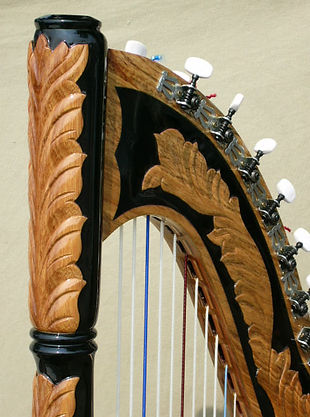
The instrument shown is the APYH-27 Professional harp made in the Gustavo Arias workshop in Asunción, Paraguay. We are grateful to Gustavo Arias for permission to use the photograph and for their contribution to the content of this piece.
* The History of Latin American harps by Dr Alfredo Rolando Ortiz, https://harpspectrum.org/folk/History_of_Latin_American_Harps.shtml
27 January 2026
Christmas card harps
Let’s look a bit more closely at those “Christmas card” harps. The instruments are tall and thin, looking a little like angel’s wings, but they produced a sound we might not associate with angelic strumming.
These instruments are bray harps they were often depicted in art from the Middle Ages. Although they were strung with gut which might have produced a gentle sound, the strings were secured at the sound board by an L shaped pin which was positioned in such a way as to make the string vibrate against the pin. This produced a buzzing sound a bit like the braying of a donkey.
Although harsh, the notes are well sustained which made bray harps popular as dance instruments at least until the end of the 17th century, it is thought that their abrasive tone made them particularly suited to carrying through a crowded room.
These details from two paintings by Gerard David and Hans Memling which date from the late fifteenth and early sixteenth centuries clearly show the bray pins where the strings of the harps meet the sound boards.

From Virgin and Child with four angels,
Gerard David, 1510-1515, Metropolitan Museum of Art, New York


From Madonna and Child with Angels,
Hans Memling, after 1479, National Gallery of Art Washington

Bray harps can be found in several museums such as this instrument at the Grassi Museum für Musikinstrumente der Universität Leipzig in Germany. It is thought to have been made in south Germany at the end of the 15th or early 16th century, though the pillar probably dates from around 1600.
Bray harps are still made today by specialist harp makers, particularly those with an interest in early music instruments; recordings of their sound can be found on various social media sites.

9 January 2026
The harp in the novels of Jane Austen
The novelist Jane Austen was born two hundred and fifty years ago on 16 December 1775. She is best known as the author of six novels which concern the lives of young women amongst the landed gentry in early nineteenth century England. Although Austen was not herself a harpist, she would have been very familiar with the instrument as one of her sisters-in-law and one of her nieces were accomplished players. The harp was a very popular instrument at this time amongst wealthy classes, so does the instrument feature in Austen’s books?
None of the lead characters in any of the novels plays the harp but of the six books only “Northanger Abbey” fails to mention the instrument. In “Sense and Sensibility” there is just a passing reference in which we are told that while attending a musical party Elinor is not much interested in the grand pianoforte, harp or violoncello. “Emma” fairs little better, the single point at which a harp is mentioned being when Mrs Elton is trying to coerce Jane Fairfax into becoming a governess, she says that “knowing” the harp would apparently improve Jane’s employment prospects.
The first novel in which one of the characters plays the harp is “Pride and Prejudice”. Here in an exchange with Mr Darcy, Miss Caroline Bingley says “Tell your sister I am delighted to hear of her improvement on the harp” Unfortunately we hear no more about Miss Darcy’s playing although in the 1995 BBC adaptation of the novel a beautiful Grecian is on display in the drawing room at Pemberley.
The Musgrove family in “Persuasion” own a harp and it would seem that both Louisa and Henrietta play. Austen describes how the instrument adds to the confusion of the parlour, along with the “grand forte-piano … flower stands and little tables placed in every direction”. Later in the book a delightful image is conjured when Louisa arrives on foot to visit her sister-in-law, explaining that this allowed more room for the harp in the carriage.

Eliza Ridgley by Thomas Sully 1818
National Gallery of Art Washington
.jpeg)
It is in “Mansfield Park” that the harp makes a significant contribution to the plot. The harp is mentioned in the text long before it appears amongst the cast. The instrument belongs to Mary Crawford who has arranged for the harp to be sent from London to Mansfield Parsonage where she is visiting her sister. Mary understands the harp has arrived at Northampton but because the local farmers are engaged with the harvest no horse and cart can be hired to complete the journey. The instrument is eventually brought in a barouche, a rather elegant carriage.
Mary is a beautiful young woman and a skilled harpist and before long Edmund is falling in love.“The harp arrived, and rather added to her beauty, wit, and good-humour; …
“A young woman, pretty, lively, with a harp as elegant as herself, and both placed near a window, cut down to the ground, and opening on a little lawn, surrounded by shrubs in the rich foliage of summer, was enough to catch any man’s heart.”
16 December 2025
Mediaeval Instruments
As we come into December, Rupert thought it would be interesting to look at a few of the instruments that sometimes appear on Christmas cards, usually in the hands of angels. The Royal Museum of Fine Arts Antwerp or KMSKA is home to a magnificent altar piece painted by Hans Memling between 1483 and 1494, it is called “God the Father with Singing and Music Making Angels”. The angels on either side of the painting are playing a variety instruments that were popular in the 15th century.

On the left as we look at the painting we see a psaltery, which looks a bit like a small horizontal harp, the strings could either be plucked or bowed.
Next is a tromba marina, this is a long stringed instrument which is bowed, its name comes from its sound which, because of the shape of the instrument and its bridge, resembles a trumpet.
The adjacent lute is easy to identify, this is a plucked stringed instrument similar to a guitar or mandolin but with a deep round back.
Then the first of the trumpets. At first sight this looks like a trombone, in fact it is a slide trumpet. The angel holds the mouthpiece next to their lips while sliding the main part of the trumpet to and fro to produce new notes.
On the far right of the first group of angels comes the shawm, this is a double reed instrument with finger holes used to produce a range of notes, a bit like on a recorder, it is probably a forerunner of the oboe.

The second group of players begins with another trumpet, this long straight instrument has no valves or slides, it is called a natural trumpet; different notes from the harmonic sequence can be produced by the player changing the tension in their lips. Then follows a second slide trumpet.
The large instrument in the centre of this panel is a portative organ, this is a small keyboard instrument with pipes; sound is produced when the player depresses keys whilst simultaneously operating a hand bellows.
Next comes a harp, every angel should have a harp, but Rupert will return to this style of harp at a later date.
Finally we see a viol, this instrument was made in various sizes and was bowed like a violin or viola, but like a guitar it has frets to fix the places where the player shortens the strings.
Rupert is lucky to be able to look closely at a modern reconstruction of the Memling slide trumpet. This instrument was hand-made for Katie in 2017 and carries the inscription "ΚΛΥΤΕ ΜΕΥ" which is an Ancient Greek declaration meaning "Hear me"


9 December 2025
The Harp Star, Vega, and the constellation Lyra

Lyra by Jacquie Parkinson
During the summer months in the northern hemisphere one of the brightest stars in the sky is Vega, the Harp Star. The star is about 25 light years away from Earth, it is the first star to be seen in the night sky during July and August, visible almost directly overhead. For many years Vega was used as the zero point on the brightness scale against which other stars and planets were compared.
The Harp Star is the brightest star in the constellation of Lyra which represents the lyre of either Hermes or Orpheus, it consists of five main stars which are visible to the naked eye.
The constellation has been identified and described since ancient times. The short passage below is from Phaenomena, a poem by the Hellenistic poet Aratus, who lived from 315 to 240 BC. It describes how Hermes placed the tortoise Lyre amongst the stars:
“And the Tortoise – she’s a little one. When barely out of his cradle, Hermes hollowed her out and named her the Lyre. He put her down before the Image of the Unknown Man, bringing her into the heavens. The Image, stretched out on its legs, moves with its left knee towards the Lyre. On the other side, the top of the Bird’s head turns around her. So between the head of the Bird and the knee of the Image, the Lyre is placed”
In more recent times the Unknown Image and the Bird have become known as Hercules and Cygnus.
We are very grateful to the textile artist Jacquie Parkinson for granting permission to use her beautiful representation of Lyra. It is a detail from “Universe” one of the panels in her magnificent work “Threads Through Creation”.
27 November 2025
Celtic Harps

Queen Mary Harp
National Museum of Scotland
The development of the harp across Europe and the rest of the world was a process in which various different types of harps overlapped with each other. As modifications in design were made, former harps became more or less fashionable, but rarely fell completely out of favour.
Celtic or clarsach harps, which are called cláirseach in Irish and clàrsach in Scottish Gaelic, are among the oldest form of harp still in use in Europe. These harps are broadly triangular in shape with a curved front pillar and a large sound box. They are clearly recognisable as similar in design to the instrument pictured on the Nigg stone (21 October 2025).
Three very old Celtic harps survive today
-
the Trinity College Harp in Dublin, also known as Brian Boru’s harp which is thought to date from the 14th or 15th century
-
the Queen Mary Harp and the Lamont Harp or Clàrsach Lumanach, both of which date from the 15th century and are displayed in the National Museum of Scotland.
Originally such harps were strung with either gut or wire, with seven strings per octave in a single key signature.

Clàrsach Lumanach
National Museum of Scotland
13 November 2025
Early European harps
The first artistic representations of harps in Europe date from the 7th and 8th centuries AD as sculptures in Ireland and Scotland. It is not clear how the harp arrived in the British Isles but it is possible that trading nations such as the Phoenicians brought instruments from the Mediterranean.
Unlike ancient Egyptian and Sumerian instruments, these early images of harps show clearly that the harp consisted of a frame of three parts: a neck, a resonant chamber and a pillar or column. The strings run between the neck and the resonant chamber, and are broadly parallel to the column. The harp frame would have been made of wood and the strings of metal, gut or animal hair.
In Old European languages the instrument was variously called ‘harpe’ (Old English), ‘harpa’ (Norse) and ‘harfe’ (Old German).

The picture shows a pencil sketch of the reverse side of the Stone of Nigg, an eighth century Pictish cross-slab, from the parish church of Nigg, Easter Ross, Scotland. The front of the slab displays an elaborately carved cross while the reverse illustrates various images possibly relating to King David. It provides one of the oldest representations of a European triangular harp. This engraving was taken from “A Short Account of some Carved Stones in Ross-shire, accompanied with a series of Outline Engravings" by Charles Carter Petley (1780 - 1830), which was published in Archaeologia Scotica, vol IV, in 1857.
21 October 2025
The invention of the harp, as told by Homer, Katie and Rupert
The first days in the life of a god are often eventful. Hermes was the son of a Maia, a goddess who lived in a cave on Kyllini, and Zeus, king of the gods on Olympus. Gods, like most animals, are up and about from the start, and so on the day he was born Hermes set out to on his adventures…
‘As he stepped out over the threshold of the high-roofed cave, there he found a tortoise, and gained ten thousand blessings. Hermes was the first to make the tortoise a singer. He encountered her at the courtyard gate while she was grazing on the thick grass in front of his home, waddling on her feet as she went. When the luck-bringing son of Zeus saw her, he laughed and said these words:
“A sign for me, already, and a very lucky one! I’m not complaining. Greetings, lovely being, beat of the dance, companion of the feast: pleased to meet you. Where did a mountain dwelling tortoise get that beautiful toy to wear, that shining shell? I’ll pick you up and take you home. You will help me and I will not dishonour you, but first you will bring me luck. Better to be at home, since it’s riskier outdoors. For you will be a protection against evil influence while you live, though if you should die, then you’d make beautiful song.” '

Hermes on the Tortoise by Ludwig Keiser
Kunsthaus Zurich
The scene that followed may be upsetting to animal lovers and tortoises, so Rupert, like the kindly carnivore he is, insisted we cut it. Suffice it to say, before long Hermes ended up with a hollow tortoise shell that made an excellent resonant chamber, and with a few additional features became the world’s first lyre also called a phorminx, harp or kithara.
After all this creativity, Hermes was feeling hungry, so he went to look for something to eat. He stole the cattle of his half-brother Apollo, the archer god, the son of Zeus and Leto. But Apollo tracked Hermes down, dragged him from his cradle, and carried him off to face the consequences. Things were getting a bit out of hand, when Hermes had an idea…

White kylix depicting Apollo and the lyre, Delphi
Photo by Dennis Jarvis
‘Easily, Hermes softened glorious Leto’s son, the Far-Shooter, just as he wish to, even though Apollo was stronger. Taking the lyre in his left hand, with the plectrum he tried each string turn. Under his hand she rang, breathtaking. Phoebus Apollo laughed, delighted. The lovely cry of her ineffable voice went through his soul and sweet desire stirred in his heart as he listened… Love, against which all arts fail, seized the heart in Apollo’s breast, and speaking winged words to Hermes he said:
“Cow killer, artful labourer, companion of the feast: this thing of yours is worth fifty cows!” '
And thus Hermes paid for the cattle with the tortoise shell lyre he had made.
4 October 2025
Harps in ancient cultures
Harps of one kind or another have been in existence for thousands of years. The first known harps originated in ancient Sumer in southern Mesopotamia and in Egypt around 3,000 BC. These instruments were mostly either bowed with strings running from one side to the other of the bow shape or angular with strings cutting across the corner of the instrument, although there are some images of frame harps which have a fore pillar.

Angle Harp Egypt Museum 2019
Typically these early instruments, called balang in Sumer and benet in Egypt would have had up to seven strings. In later instruments the number of strings increased.
Harpists in ancient Egypt were highly esteemed and the names of several such as Hikino and Nebnefert have been found recorded over the ages.

Egyptian Bow Harp
Metropolitan Museum New York
2 September 2025
Fans of the Harry Potter books will be well aware that the first book in the series centre’s around the existence of the Philosopher’s Stone, a stone which is the source of the Elixir of Life. Hermione, Ron and Harry realise that the stone must be hidden at Hogwarts and they believe that someone is trying to steal it. However, the staff at Hogwarts have devised various hazards which any potential thief must overcome. Before the trio can reach the stone to confront the thief they must get through the Devil’s Snare plant, catch a flying key, play a dangerous game of Wizard’s Chess and solve a riddle about potions.
But first they must get past Fluffy, the huge three headed dog belonging to Hagrid, who guards the entrance to the secret hiding place. Hagrid has let slip that Fluffy can only be calmed by the sound of music. When Harry and his friends begin their quest, they find Fluffy slumbering on a trap door with a harp playing magical music to keep the dog asleep.
Like many others Rupert wonders if he might not have enjoyed being at Hogwarts.

18 August 2025

Congratulations to Katie’s former student Bethany Coggon who was awarded the inaugural Royal Welsh College Brooch for Harp Excellence by RWCMD President Dame Shirley Bassey at the College’s annual dinner in June.
The brooch, formerly used by the Official Harpist to The Prince of Wales, has been given on permanent loan by the King, who is Patron of the Royal Welsh College of Music & Drama. It will be awarded annually to the harpist who achieves the highest mark in their summer recital.

29 July 2025
Aeolian harps are very ancient musical instruments, they are formed when strings are stretched between two or more fixed points. The sound is produced by wind moving over the strings. In some cases the strings are stretched over a sound box, but they can also be arranged simply to allow air to move past the strings. The instrument is named after Aeolus, the Greek god of the winds.

Metropolitan Museum, New York
Aeolian harps are mentioned in the Bible in Psalm 137 where the the poet says "By the rivers of Babylon ... on the willows we hung up our harps".

Prof. Henry Gurr
21 July 2025


This afternoon Rupert took part in a parachute jump from the top of the church tower at Calstock, Cornwall. He managed to successfully land in the middle of the target area and his courage was rewarded with a badge
29 Jume 2025
Thomas Moore was an Irish Catholic, the son of a Dublin grocer. His poetry and songs were popular in Regency England. In 1807 Moore wrote "The harp that once through Tara's halls" which reflects the loss of Irish culture under English rule in Ireland.
.jpeg)
The harp that once through Tara's halls
The soul of music shed,
Now hangs as mute on Tara's walls,
As if that soul were fled. —
So sleeps the pride of former days,
So glory's thrill is o'er,
And hearts, that once beat high for praise,
Now feel that pulse no more.
No more to chiefs and ladies bright
The harp of Tara swells;
The chord alone, that breaks at night,
Its tale of ruin tells.
Thus Freedom now so seldom wakes,
The only throb she gives,
Is when some heart indignant breaks,
To show that still she lives.
14 June 2025

Harps are like tulips -
Tulips don't shout for attention; they bloom in quiet grace.
21 May 2025
Katie McClaughry - Wedding Harpist